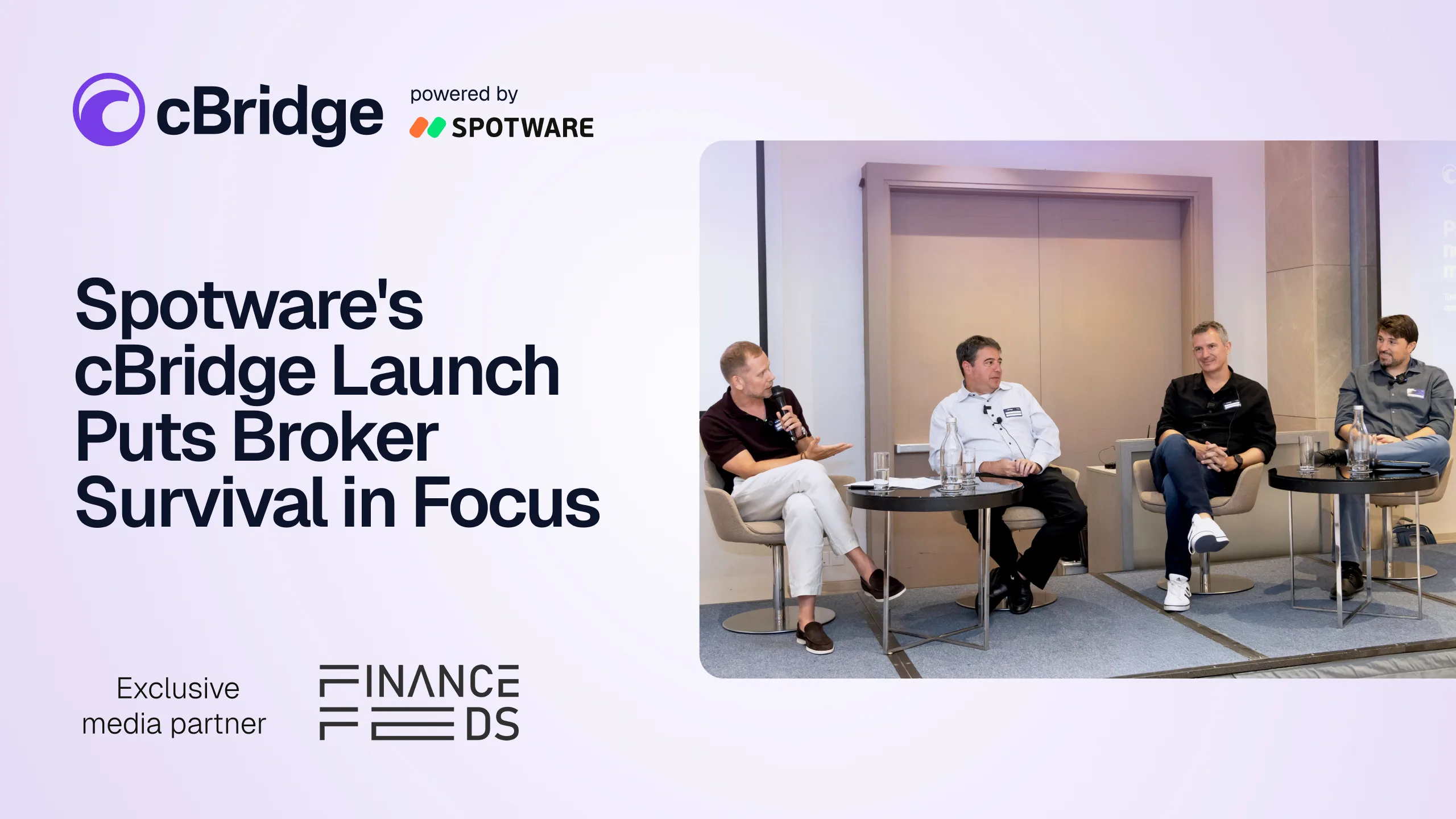
Toxic Flow, Execution Quality, AI and Competition Dominate Limassol Discussion
Spotware‘s private cBridge meetup in Limassol was designed to introduce brokers and industry professionals to a new bridge solution and open a discussion around toxic flow, execution quality and liquidity management. By the time the event concluded, however, the conversation had expanded far beyond bridge technology. What began as a discussion about infrastructure evolved into a broader examination of how brokers can remain competitive in a market shaped by increasingly sophisticated traders, growing operational complexity, artificial intelligence and competition from larger financial institutions.The event also served as the first public appearance by Alexis Droussiotis following his recent appointment as Co-General Manager of cBridge. Spotware recruited Droussiotis to help lead the next stage of cBridge’s growth, bringing experience from brokerage technology, liquidity connectivity and trading infrastructure. Joining him on stage were Drew Niv, Chief Strategy Officer at ATFX, and Jonathan Squires, CEO of Tapaas. The discussion was moderated by FinanceFeeds Editor-in-Chief Nikolai Isayev.While toxic flow remained a central theme throughout the evening, the strongest takeaway was arguably broader. The speakers repeatedly returned to the idea that many brokerage firms continue to treat infrastructure decisions as technical matters when they have become strategic business issues. Visibility, execution quality, data management, risk controls and technology investment all appeared as recurring themes, culminating in a discussion about whether brokers are adequately prepared for a future in which AI, crypto exchanges and large online financial platforms become increasingly direct competitors.
Why Alexis Droussiotis Thinks Bridge Complexity Has Become a Business Risk
Alexis Droussiotis opened the event by addressing a challenge that rarely receives the same attention as trading platforms, liquidity providers or client acquisition. According to him, bridges have quietly become one of the most complicated components inside many brokerage operations.“Bridges, they quietly become one of the most complex parts of the brokerage.”The complexity often develops gradually. A broker adds new liquidity providers, introduces new routing rules, deploys additional trading platforms, creates custom configurations and builds operational workarounds over time. Years later, the result can be an infrastructure layer that few people inside the organization fully understand.“We’re seeing that layers and layers of configuration are added, bridges become extremely heavy,” he said. “We’re seeing that knowledge lives with only one or two people, and if these knowledgeable people actually leave, you don’t have team members to actually figure it out.”That observation resonated with many operational professionals in attendance because it reflects a problem that extends beyond technology. When critical knowledge becomes concentrated among a small number of employees, infrastructure stops being merely a technical asset and becomes an operational dependency.Droussiotis argued that brokers often underestimate the risk created by that dependence. Teams become reluctant to modify configurations because they no longer fully understand how different parts of the bridge interact with one another.“Without visibility in what is actually happening in the bridge itself, every change feels actually risky.”The solution presented by Spotware focuses on visibility, dependency mapping and validation. Rather than requiring users to navigate through multiple disconnected tables and configuration layers, cBridge was designed to expose relationships between different settings and highlight potential conflicts before changes are pushed into production.“What we want to do is take brokers from complexity and give them control.”The discussion also touched on another issue that Droussiotis believes deserves more attention: infrastructure pricing. Traditional bridge pricing models often rely heavily on volume-based fees, meaning that technology costs rise alongside trading activity.“Cost scales with every million traded, so the strongest month for a broker is also their most expensive.”Droussiotis argued that this model creates an unusual situation where business success automatically increases infrastructure costs. In contrast, cBridge focuses on connectivity and infrastructure rather than trading volume, giving brokers a more predictable cost base.For brokers reviewing legacy bridge setups, that can create a clear opportunity to modernise their infrastructure while reducing bridge costs by up to 80%.“Every dollar spent on volume fees could have been one dollar spent on growth in the company.”While pricing was not the dominant theme of the evening, the broader argument about operational efficiency and scalability would reappear throughout the panel discussion.
Toxic Flow Is Becoming More Difficult to Define
The roundtable began with a question that appears straightforward but quickly revealed different viewpoints among the speakers: what exactly is toxic flow?Drew Niv approached the issue from a commercial perspective.“Different brokers define it differently,” he said. “Generally speaking, it’s flow you can’t monetize.”That definition shifted the discussion away from the simplistic idea that toxic flow is merely profitable trading. Instead, Niv suggested that the classification depends largely on a broker’s business model, execution framework and ability to manage specific types of trading activity.Jonathan Squires offered a different perspective. He distinguished between skilled, legitimate trading and strategies that systematically exploit technical vulnerabilities or execution gaps.“We classify true toxic as the guys that systemically abuse the system.”According to Squires, these cases can include stale-price arbitrage, technical vulnerabilities and cross-venue strategies, where differences in execution, pricing or account structures across brokers may create additional risk for brokerage operations.“We saw 29,000 accounts in one day doing external arbitrage between two of our brokers.”Droussiotis proposed another framing.“I like to call it the unwelcome flow.”His argument was that the same trading activity can be acceptable for one broker and problematic for another. Toxicity often depends on execution models, liquidity arrangements and risk-management approaches rather than the trading strategy itself.Droussiotis also differentiated between retail and institutional forms of toxic flow. In retail trading, some strategies can be harder to manage if a broker’s pricing, routing or execution setup is not fully aligned. Institutional participants may use automation, superior infrastructure and better access to market information.One point generated broad agreement. The reaction window available to brokers continues to shrink. Years ago, firms may have had hours or even days to identify problematic activity. Today, automation and faster execution mean that small inefficiencies can be exploited almost immediately.“Even small windows in the day, if they open and they can have systematic abuse, it’s an issue.”The result is an environment where visibility and monitoring become increasingly important. Toxic flow is no longer simply a dealing desk issue. It has become a technology and infrastructure challenge.
Why Brokers Continue to Leak Millions
One of the strongest parts of the discussion came when Niv turned to the financial consequences of execution inefficiencies.“Every broker leaks millions of dollars to toxic flow every year,” he said. “If you look at big brokers, tens of millions of dollars.”The statement was not presented as an attack on brokers. Rather, it was a criticism of an industry tendency to underinvest in infrastructure while focusing heavily on client acquisition and growth.According to Niv, many execution problems remain surprisingly solvable.“There are easy commonalities to combat toxic flow that most people don’t invest in.”A major example involved market data. Niv argued that brokers offering products linked to futures markets often fail to monitor the underlying markets closely enough.“If you are pricing a CME-based instrument like gold, like S&P 500, you have to have a futures feed too.”Many brokers rely primarily on pricing from liquidity providers. That may reduce costs, but it can also create blind spots.He used gold as a particularly important example. Retail brokers frequently offer highly competitive spreads and trading conditions. While they may be attractive from a marketing perspective, they can also create vulnerabilities.Niv also highlighted infrastructure decisions that contribute to execution problems.“You can’t overload the servers.”The discussion eventually shifted toward artificial intelligence, which Niv sees as a force likely to amplify existing challenges.Five years ago, traders seeking sophisticated execution advantages often needed development teams and significant budgets.“We had customers that had five programmers.”Today, many of those barriers are disappearing.“We’ve seen examples of customers who have already gotten extraordinarily sophisticated in what they’ve been able to do with very little work.”The implications are significant.As AI tools become more accessible, traders gain access to capabilities that were previously limited to well-funded operations. That trend, Niv argued, will make more advanced trading strategies accessible to a wider range of market participants, increasing the importance of strong infrastructure and execution quality.“The amount of people being able to take advantage is about to rise exponentially.”
The Liquidity Provider Conversation Brokers Often Avoid
Another important part of the discussion centered on liquidity relationships and the industry’s tendency to treat profitable flow as toxic flow.According to Niv, many brokers are misdiagnosing the problem.“The majority of toxic flow that most brokers flag is actually hedgeable flow.”His argument was that many firms classify certain traders as toxic simply because those traders do not fit neatly into existing execution frameworks.Rather than rejecting those clients, brokers should consider whether different execution models, different liquidity relationships or different economics might allow that flow to be managed successfully.“The problem happens now when we take the stuff that’s toxic and we give it to the same LP.”Throughout the discussion, Niv repeatedly returned to the importance of segmentation. Different types of clients create different types of risk. Attempting to process all flow through identical frameworks often creates unnecessary friction.He argued that brokers, liquidity providers and clients frequently operate with mismatched expectations.The retail industry has become highly competitive. Brokers offer tight spreads, high leverage and attractive trading conditions because they must compete for clients. Liquidity providers, meanwhile, have their own risk-management constraints. Problems emerge when those realities are not acknowledged openly.“There is a solution, not for 100% of it, because there is real abuse out there that is not hedgeable, but the majority is not the case.”The message was not that toxic flow does not exist. Rather, the point was that some flow may be labelled as toxic when it could potentially be managed differently with stronger execution tools and better liquidity setup.That observation connected directly back to the earlier discussion about visibility, infrastructure and execution quality. Better data and better routing decisions often create more options than firms initially realize.
The Human Side of Infrastructure Change
One of the most interesting parts of the evening involved a topic rarely discussed in product presentations: employee behavior.When asked why brokers often hesitate to migrate away from existing bridge solutions, Droussiotis acknowledged the technical challenges involved.A bridge sits at the center of execution infrastructure. It connects trading platforms, liquidity providers and operational workflows. Replacing it is not a simple software update.But Droussiotis argued that technical considerations are often only part of the story.“The second reason for hesitation that we’re seeing is the human element.”Employees become familiar with existing systems. They learn workarounds, procedures and operational habits. Even when those systems create inefficiencies, change can feel risky.“You’re talking to a dealer and you’re telling him you need to change a bridge. But I already know my own.”The perspective differs depending on who is making the decision.“They’re looking at it from the employee’s perspective, not from a CEO or founder.”This observation tied into a broader theme around standardization and operational simplicity.“Standardize everything that you’re doing.”Without standardization, complexity compounds over time. Teams become dependent on institutional knowledge. Infrastructure becomes harder to modify. Growth becomes increasingly difficult to manage.Squires echoed similar concerns through the lens of data quality.“We need a single source of truth.”The phrase appeared simple, but it captured a recurring theme throughout the evening. Whether discussing toxic flow, execution quality or operational efficiency, better decisions depend on better visibility.
Why AI, Binance, Kraken and Robinhood Matter
The final section of the discussion moved beyond toxic flow and infrastructure into the future competitive landscape facing brokers.Niv delivered the strongest warning of the evening.“I think that brokers need to think that their existence is at risk.”His concern was not regulation. Nor was it market volatility.Instead, he pointed to the growing presence of larger organizations entering adjacent markets.“All the big crypto exchanges are coming for this industry.”He also pointed to major online brokerages.“What if they were owned by Binance tomorrow? What if they’re owned by Kraken tomorrow? What if they’re owned by Robinhood tomorrow?”The challenge is not merely scale. These firms often possess customer bases, technology budgets and distribution capabilities that many traditional brokers cannot match.“They already have 100 million clients.”Niv used Kraken’s acquisition of NinjaTrader as an example of how quickly competitive dynamics can change. Firms that historically operated in separate corners of financial services are increasingly moving into one another’s markets.At the same time, artificial intelligence may accelerate participation in trading markets. Niv described AI as both a threat and an opportunity.“If you’re in a business of getting paid by trade, AI is the best thing that could happen to you.”Higher participation and more trading activity create opportunities for growth. Yet they also increase competitive pressure and raise expectations around technology, execution quality and operational efficiency.“We have to get a lot better at what we do.”Toward the end of the discussion, Niv summarized his view with a sentence that captured the mood of the evening.“If we don’t change, we die.”The statement was not intended as a prediction of imminent collapse. Rather, it reflected a belief that the brokerage industry is entering a period where adaptation matters more than ever. Firms that improve infrastructure, execution quality and reduce unnecessary technology costs will be better positioned to capture new opportunities as the market evolves. For many brokers, this is also the right time to reassess their current bridge setup, move to more modern software and reduce infrastructure costs by up to 80%. Those that remain dependent on legacy systems and outdated assumptions could find the competitive landscape increasingly difficult.
Takeaway
Spotware organized the event to introduce cBridge, its new connectivity solution designed to give brokers greater visibility, control, and predictability across their trading infrastructure. Throughout the evening, the discussion repeatedly returned to the same themes that shaped the platform’s development: fragmented systems, limited transparency, difficulties identifying the true source of toxic flow, rising operational complexity, and increasing pressure on execution quality. Alexis Droussiotis positioned cBridge as a response to those challenges, arguing that brokers need infrastructure that simplifies operations while providing clearer insight into what happens between liquidity providers, platforms, and clients. Jonathan Squires expanded on the importance of accurate data and accountability when managing flow, while Drew Niv discussed how execution quality, artificial intelligence, and competition from larger financial institutions are raising the stakes for brokers across the industry. Viewed through that lens, the event became more than than a product demonstration. The conversations on stage illustrated why infrastructure has become a strategic issue for brokers and why Spotware believes cBridge addresses a growing need in the market. As trading environments become more complex and margins come under pressure, the ability to see, understand, and control what happens inside the liquidity stack may increasingly determine which brokers thrive and which struggle to keep pace.
Enter Your Information Below To Receive Trading Ideas and Latest News
Your information is secure and your privacy is protected. By opting in you agree to receive emails from us. Remember that you can opt-out any time, we hate spam too!